Integrating Design Thinking, Lean, and Agile
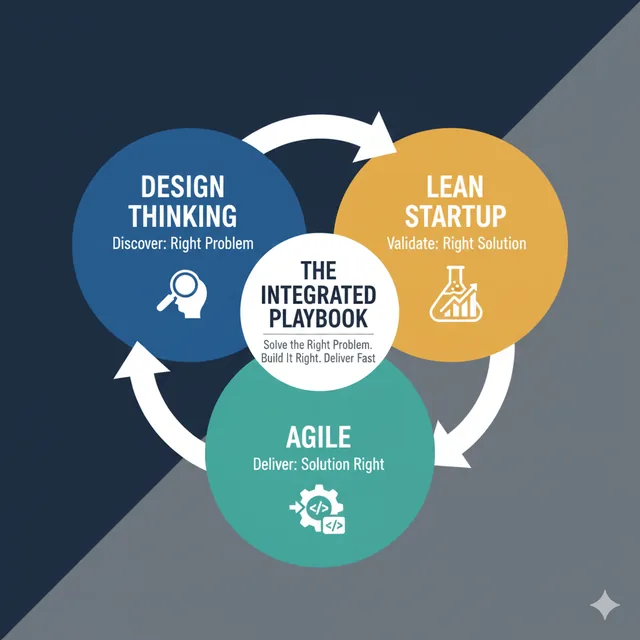
High-performing product teams don’t rely on a single methodology. They combine Design Thinking, Lean Startup, and Agile into one integrated approach that reduces risk, increases learning, and accelerates delivery.
This playbook provides a simple, powerful structure to align teams and create a continuous cycle of discovery, validation, and delivery.
Conclusion: The Integrated Mindset
The most high-performing product organisations operate these three mindsets concurrently: Design Thinking seeks the next problem, Lean Startup tests the solution risk, and Agile builds efficiently.
The ultimate question for team alignment is: "Are we using the right mindset at the right moment?"
Discovery (Design Thinking)
This phase uses human-centered methods (IDEO, Stanford d.school) to deeply understand users and define the real problem. The output of Discovery is not a finished specification, but a testable hypothesis ready for validation.
Empathize & Define
Conduct qualitative research such as interviews and field visits to understand the user’s context, pain points, and behaviours. Use these insights to create a clear and focused problem statement, often formulated as a “How might we…” question.
Ideate & Align
Generate a wide range of potential solutions, narrow them down into a clear solution concept with the riskiest assumption identified, and translate this into a testable hypothesis.
Validation (Lean Startup)
This phase is based on the principles of Validated Learning and the Build-Measure-Learn loop, popularised by Eric Ries in The Lean Startup. The primary goal is risk reduction: proving a concept's viability and feasibility with minimal investment before committing to a full build. The output of Validation is a validated, prioritized item ready to be delivered incrementally.
Formulate the Hypothesis:
Convert the Solution Concept into a clear, measurable hypothesis: "We believe that [X feature] will achieve [Y outcome] for [Z user], and we will measure this using [Metric]". This links the solution directly to a business outcome.
Build the Minimum Viable Product (MVP):
Create the smallest possible experiment required to test the hypothesis. The MVP is a learning tool, not a minimum product.
Learn and Decide:
Analyse the data to determine if the hypothesis holds true. The team must consciously decide to change the idea, continue building, or stop the idea.
Delivery (Agile)
This phase is defined by the Manifesto for Agile Software Development (2001) and its twelve principles, ensuring the efficient and adaptive execution of validated ideas. Agile is the vehicle that carries the learning from Lean Startup into the product. The output of Delivery is working software and a steady flow of new user data, pushing the team back into the Discovery phase.
Integrating with Lean Startup Informed Backlog Prioritization:
The results from Validation directly inform the priority of the Product Backlog. This aligns the Agile execution with the highest-value, validated items, eliminating waste.
Iterative and Incremental Delivery:
Use short, time-boxed cycles (e.g., Scrum Sprints or Kanban flow) for continuous delivery of working software. This embodies the Agile principle of delivering working software frequently.
Continuous Feedback and Improvement:
The Agile Sprint Review acts as a low-cost, built-in Lean Startup measurement loop, gathering feedback on working software every few weeks. The Retrospective embodies the Lean principle of continuous improvement, focusing on optimizing how the team works and reducing process waste.
References & Scope
This article is based on established principles from the Agile Manifesto, Lean Product Management, Scrum, Continuous Discovery, and SAFe’s product-centric operating model.
It applies specifically to software development and digital product delivery, and reflects the challenges commonly seen in the daily work of New Hill.