
Project vs product: the main difference every company needs to know
Nearly everything a modern digital organisation develops, from a mobile app to an online service, is a digital product. And here’s the key reality:
Digital products never stop changing.
They evolve continuously as customer expectations shift, regulations change, competitors release new features, and technologies advance.
Yet many organisations still manage digital products as if they were temporary projects, that end once something is delivered, even though the product continues to live for years.
This mismatch slows teams down, increases costs, and results in solutions that quickly lose relevance.
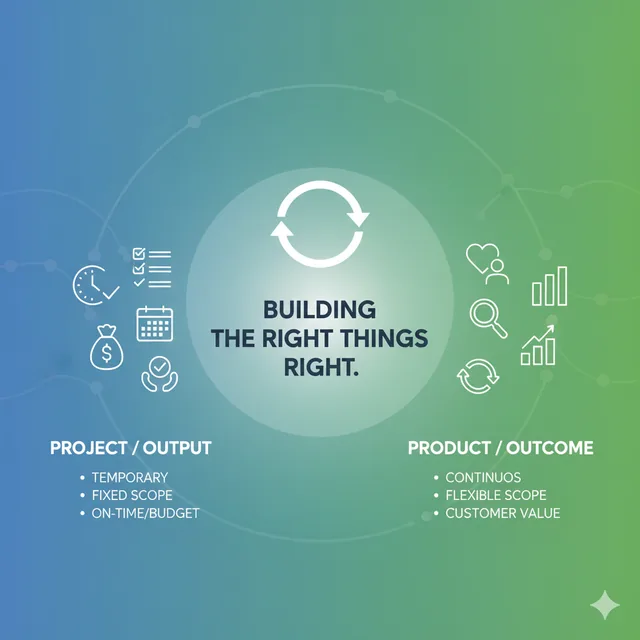
To solve this, organisations must understand the essential difference between Project Thinking (focused on output) and Product Thinking (focused on outcome).
What Is Project Management?
Project Management is built around the idea that work is finite. You define what needs to be delivered, plan how to deliver it, and execute that plan. The goal is to deliver efficiently and predictably.
A Project Manager focuses on following the agreed timeline, managing risks, and ensuring the predefined scope is delivered.
In this model, success means the work was finished on time, within budget, and according to the plan.
This approach works very well for migrations, implementations, infrastructure changes, regulatory updates, and other discrete initiatives where certainty is required upfront.
What Is Product Management?
Product Management is designed for work that is continuous, evolves over time, and is shaped by customer needs.
When a digital product launches, the work doesn’t end — it begins a new phase of learning, improvement, and adaptation.
A Product Manager (or Product Owner) focuses on long-term value: solving the right problems, refining the customer experience, and ensuring the product remains relevant.
Success is measured by whether customers use the product, return to it, find it valuable, and whether it helps the organisation achieve its goals.
Product Management accepts that scope will change as teams discover what truly drives value.
Why They Need Each Other
Although Project and Product thinking approach work differently, they complement one another.
Digital organisations still require project skills for large, time-bound efforts such as launching major features, preparing for regulatory deadlines, or migrating to new platforms. Project management provides structure, coordination, and clarity for these initiatives.
At the same time, Product Management ensures that once something is launched, it continues to evolve and deliver value rather than becoming outdated or misaligned with customer needs.
Project Thinking ensures efficient execution.
Product Thinking ensures long-term effectiveness.
A helpful reflection is this:
Do you celebrate the launch, or do you celebrate the value delivered after the launch?
This distinction reveals whether your organisation focuses on output or outcome.
Why This Shift Matters
The move from Project to Product thinking has become essential because digital markets evolve faster than traditional project cycles can support. Customer needs are constantly changing, competitors improve rapidly, and technology shifts continuously.
Product thinking helps organisations reduce waste by learning early which ideas work and which do not. It encourages experimentation, user feedback, and continuous improvement.
Where a project aims to deliver an entire list of requirements, a product team aims to discover which requirements matter most and ignore the rest.
Digital products cannot survive on a “deliver once and walk away” approach.
Conclusion: The Mindset Shift
The real difference between Project and Product Management is not found in job titles or tools — it is a shift in mindset.
Projects aim to finish work.
Products aim to improve work.
Projects deliver outputs.
Products deliver outcomes.
Projects end.
Products continue.
If you examine your current digital budget, what do you see?
Temporary projects or sustained value streams?
Your answer reveals whether your organisation optimises for output… or outcome.
References & Scope
This article is based on established principles from the Agile Manifesto, Lean Product Management, Scrum, Continuous Discovery, and SAFe’s product-centric operating model.
It applies specifically to software development and digital product delivery, and reflects the challenges commonly seen in the daily work of New Hill.